Bienvenidos!

Welcome to my blog about experiences that have challenged, encouraged, and confused me. These are mere words that don't even come close to capturing the joy, pain, and laughter I have shared with extremely beautiful people.

Friday, October 22, 2010

Somos en búsqueda.

Three Romero posters, one semi-tanned body, and lots of Pops ice cream receipts later, I will take many things with me as I leave El Salvador tomorrow. But more importantly, I'll forever have with me the stories, images, and sounds of this beautiful tiny country.

I have learned so much over just a short span of four weeks. I have learned the true meaning of liberation and the many definitions of oppression. We've explored the realities of so many people, walking with them through their stories of pain, desperation, death, violence...of hope, joy, and strength.

I have met God anew.

I have seen God in the faces of the trapped gangsters that we view from the TV screen. I have heard God in the passion of the voices of the lesbians fighting for their rights. I have felt God in the energy of the volunteers at the Peace Center in Suchitoto. I have seen God in the excitement of the people of Usulutan. I have received God's word in the signs of "Basta ya!" (which mean "Enough!"). I have seen God in the patience of the little girl who taught me how to play jacks. I have heard God in the calming words of our coordinators. I have heard God in the flute music produced by teenage boys of Nueva Esperanza. I have experienced God in unexpected ways.

My view of God has been stretched, misconstrued, challenged, questioned, attacked, and transformed...and I love it.

Today I created a project about liberation theology and what my learning about it has done for me. I have discovered the many ways I myself have yet to be liberated...liberated from myself. My eyes have been open to the liberation needed back home, in the lives of the people closest to me. I have realized the need for liberation in my sisters and brothers around the world. I have learned that your own reality is not something to ignore, not something to push back. It's something to embrace.

I apologize that I'm not really getting into so much depth about this. I think that is because I am still in the process of taking in this overload of information and figuring out what it is I am being called to do with all this information.

Nothing will replace the huge amount of things that I have learned this month. In a little over week, we will be on our way to Nicaragua, to encounter yet another reality. Why won't we be there for another week?? Because we have fall break, of course! :) Tomorrow, my friend Laura and I will get on a bus heading south, first through Honduras, then through Nicaragua, then we'll arrive in Costa Rica Saturday night. We'll spend a day there, then hop on another bus to Panama and spend a few days there. Then at the end of the week, we'll make the trip back up north to Nicaragua. By the end of next week, the only Central America country (not counting the Caribbean) I will not have visited is Belize. :)

I am beat, but I hope I have more to say about El Salvador soon, when I'm not so tired.

I encourage you to do some research on this small country. I found a website for a documentary with a trailer that gives a great synopsis of the status of El Salvador: http://www.returntoelsalvador.com/. Also, there is a man who keeps a great blog about happenings in El Salvador: http://luterano.blogspot.com/. Scroll down to find a topics listing, and find something that might interest you. There are also many videos and documentaries focusing on El Salvador (I have watched Romero and La vida loca [about gangs], but there are so many more [Return to El Salvador, Which Way Home, and Si Nombre all touch on immigration].

It's a lot of info, but I need to get the word out about this small, full-of-potential nation. (And right now I just don't have the energy to type it all out!) Let me know what you know or find out about El Salvador.

As always, thanks for reading! We'd appreciate prayers as we spend a total of over 40 hours on buses in the next week. :)

Somos en búsqueda. We are always searching.

Wednesday, October 13, 2010

80 choco-bananas later...

The past two weeks have been oober memorable for me. I will try not to make this post seven pages long. :)


Last weekend our group split up to visit different communities throughout El Salvador for a "church accompaniment weekend." Three of us traveled to Usulután, a city a few hours away from San Salvador. We spent the weekend riding around in the back of a pickup truck, visiting surrounding communities and their church events. Not only did I get to learn more about the Lutheran church in El Salvador (which is fairly new  and pretty small), but also we got to see a lot of the area. We visited one of the smaller churches and its shrimp hatchery in the back. During "shrimp season" the youth collect the shrimp and sell it to raise money for youth and community funds. Also, we saw some flood damage in another community. We could only drive a little ways on the street into the community before we ran into acres of water. We were informed that beyond the water was a community of 180 people and five more communities beyond that. Many of the people were living on rafts, refusing to leave in fear of losing their homes and belongings. After this, we drove through a river-sometimes-road to get to Pastor's home. There was water everywhere, both due to flooding and just due to a casual rainfall (the road is a river when it rains and a bumpy dirt road when not raining). We stayed in the pastor's brother's abandoned house (his brother is in the US), just a few hundred feet away from his house. We had two fun nights falling asleep under the shadows of fluttering bats, to the feeling of ants crawling about our legs, and to constant rooster crows, cow moans, and dog barks. We learned a lot about "liberation theology in action." The church was very much focused on its youth. We visited a youth group session that included a Bible study and some games. So fun. :) Many of their goals also include raising the funds to hold retreats and birthday parties, especially for the youth. The church's goals including events to unite the multiple communities. Sometimes it was hard to see how this church community lied within "liberation theology," mostly because there seems to be a lot of need in the area--due to hunger, flooding, sustaining themselves, etc. But I am realizing now there is a lot of legitimacy in their efforts to unite and empower their church. I hope their efforts keep growing and result in even greater transformation in their communities. 

Our church accompaniment

Some of the flood damage (and a not-so-happy vaca)
This past weekend provided another great adventure to another great community. We traveled as a group to the community of Nueva Esperanza (in English, "New Hope") in the Bajo Lempa region of the country. I LOVED this community, which 500 people call home. To me, the people of this community are the epitome of liberation theology. They are truly united as a community, working together to do some great things for themselves. Some of these include going to the government to fight for their rights to dry land--Bajo Lempa lies on the Lempa River which has flooded the near communities many times (probably multiple times a year).  The severity and frequency of the flooding is due to discharge from a hydroelectric dam. They have asked these discharges to be regulated. This year only 3% of their corn sustained the floods. They simply want to be able to grow their food and live safely in their homes without so much water all the time. We also visited with a "Health Emergency Fund," an organization that helps residents travel to the city for their check-ups, provides events for the older residents, and even has worked to partner with Venezuela in a program that allows Salvadorans to travel to Venezuela for cataract surgery for free. We also toured the coconut and sugar cane fields (including some sipping of coco milk and gnawing on sugar cane...mmm, so good!) The community has also been focused on the youth, providing many opportunities to get involved in soccer tournaments and music groups. Whenever we walked around the community, we could always hear a band practicing or would run into a teenage boy walking down the road, practicing his flute. A highlight of my weekend was also finally being beneath a clear night sky, with zero clouds and limited light pollution. Two nights we found ourselves lying in the soccer field, counting shooting stars. :) One night we also had a great view of a late-night futbol match from the top of the water tower. Every day also included one or two (or six...) visits to the choco-banana woman. She made 80 choco-bananas before we got there on Thursday...they were gone by Sunday morning. :)
Sipping some coconut milk
and eating coconut meat
Gnawing on some deliciously sweet sugar cane
A musical group from Nueva Esperanza
performing for us (they were so good!)
Oh, did I mention the adventures we've had on our days off? :) Last monday: a day of relaxing in hammocks and frisbee on the beach. Yesterday: a hike up the tallest Volcano in El Salvador. Tonight: bowling. :)


Pacific Ocean :)
The crater of Santa Anna Volcano -- the tallest volcano in El Salvador
There is so much I haven't included...(including a visit to a great photo exhibit about immigration, a talk with the head of the religion department of the UCA, and some great class sessions.) Overall, I'm still having the time of my life. Every day is an adventure...and an amazing learning experience. 


Cómo estás? Let me know how YOU are doing! (I'd also like to know that someone is actually reading these posts!) I really welcome questions and/or comments. :) Thanks for reading! Hasta la próxima!

Monday, October 11, 2010

What is Liberation Theology?

I'd like to share with you parts of my first essay exam for my Liberation Theology course. I kept out most of the academic stuff and brought out my own analysis and definitions. Hopefully it will give you some understanding of the LT movement. If you're looking for an update of what I've been doing, it'll come in a later post (hopefully tomorrow), but liberation theology has been the backbone of all I've been learning and doing--it is what I have been studying, living, and breathing for the past two weeks.

I have developed my own definition [of liberation theology], which includes the following:
Everyone needs to know they are beloved.  Jesus told his disciples that the greatest commandment is to love.  In order to be empowered yourself, you need to know that you have worth.  I think this should be the first and foremost goal of liberation theology, or any theology in that case.  This goal is not accomplished by imposing beliefs or trying to persuade someone to adapt a new culture.  It is done through relationship and compassion.
We must work from the bottom up.  Liberation will not happen unless the recipients are the ones in control.  Liberation theology is the first way of doing theology that starts with the people, and then becomes an analysis of their reality. 
Reality comes first.  Rather than developing a theology and believing this theology must be applied, the roles are flipped, and the theology becomes affected by reality and changes as reality changes.  It is the “voice of the voiceless.”  Change will not come about by imposing my theology upon a people, rather experiencing where the people are and asking them if my gifts can be used to assist their search for their voice.  
Where is the God of life? When examining reality, it is important to keep in mind how we are defining God, or why we are calling it theology.  How are these people being kept from living fully?  Are they experiencing life or oppression?  God for me is life and mystery.  In our actions, how am I allowing this beautiful mystery work itself out?
The call is for transformation.  Liberation theology is not just about change.  It is about a transformed mind, transformed belief, and transformed hearts.  Without internal transformation, it becomes a fleeting method, which includes a hand-out here or there, but never really a full empowerment of the oppressed. 
Liberation needs to happen now.  Too much focus has been put on what will come after this life, when we will finally see “Jesus face-to-face.”  Even scripture has been interpreted to say that it is okay to be poor now because when we reach that life-after-death, there will be no more suffering.  As a believer in a living God who is fully present and active in the world here and now, I see our call for liberation as present and urgent.
Liberation theology lies within the parent who will tell their gay child “I love you” rather than “There’s something wrong with you.”  It lies within the woman who can finally speak about her experience of being raped.  It lies within the scarred student who can finally go to school without the fear of being bullied.  It lies within the Lakota woman who sees her people as more than just alcoholics.  It lies within the youth pastor who helps a lonely teenager realize that he is not alone.  It lies within the child who after years of going to bed hungry, finally falls asleep without a rumbling belly.  It lies within the churches that not only hold an “all are welcome” motto, but actually live it out. 
Liberation theology is stirring.  It is not something that we anticipate to happen; it is happening and must happen now.  As Boff said, there is urgency. Until the oppression is gone and until justice prevails, liberation theology will always be relevant, and it will always be changing. ...
Hope is a heavy word.  But I believe we cannot talk about the future of liberation theology without using this term.  To believe that liberation will come about is to have some hope—not only in the method of theology, but in people.  I keep thinking about what our guide at the Romero Center told us.  The deaths of the Jesuit martyrs were not in vain; they serve as “sources of hope.”  So much violence and so much death have not resulted in just a mourning country, but a morning country.  A dawn is coming, hope is present.  Hope is not just a goal of liberation theology; it is a driving force and an active participant.  There is hope that repression, violence, and cruelty will cease.  There is hope that the God of life will finally be revealed in all of God’s children. 
In short, liberation theology is a new way of not only doing theology, but a new way of thinking and living.  Especially for believers, it asks questions about who exactly is God and how we are allowing God to be revealed.  It is a theological method not like any others because it opens itself up to constantly being refined and changed as reality emerges.  Liberation theology provides hope for the marginalized not just because it fights against oppression but because it allows all people to see themselves as capable of empowering themselves and being fully alive humans.

Friday, October 1, 2010

Holy Ground

This past week has been heavy.  Not only are we discussing deep issues in our liberation theology class, but our "field-trips" and speakers complement all of our heavy themes. The word "martyr" is always in the air. On Tuesday we visited the church of Oscar Romero, former archbishop of El Salvador who was assassinated in 1980 for his speaking out against the repression and violence. I have acquired a huge admiration for Monseñor Romero. Everyone who speaks of him, speaks with a great respect and with so much passion. Monseñor Romero had the guts to speak out and people listened. He sacrificed himself for the liberation of his people. A famous quote of his: "If they kill me, I shall arise within the Salvadoran people."


I have also learned that in the year I was born, an unjust and bloody massacre occurred on the campus of a large university here in San Salvador. We visited the University of Central America, where in November of 1989, the lives of 6 Jesuit priests and 2 women were taken by members of the Salvadoran army. They attempted to make it seem like a guerrilla encounter, but the evidence shows no sign of that. These men had been working against the oppression and injustice, and became just a handful of the many who were killed in efforts against the injustice.


My words cannot even begin to express these things; these things are simply indescribable. The images, the words, the feelings. This country is suffering. I can see the pain in people's eyes. But I can also see hope. Our speaker at the Romero Center yesterday told us that the deaths of the Jesuits were not in vain and they did not necessarily discourage the people; they served as sources of hope. So much blood has been spilled, everywhere we go. The blood has left stains that are not forgotten.


This is holy ground.

Monday, September 27, 2010

I've got a feeling we're not in Guatemala anymore...

San Salvador: Part of Metrocentro; a view close to our guest house
When you picture Central America, do you see huge shopping malls, with escalators, food courts, and overpriced cinnamon rolls? After a day and half in San Salvador, we have visited one of the many many shopping centers in the city, and our guesthouse is a short few blocks away from the largest mall in Central America, Metrocentro.

Crossing the border into El Salvador was surprisingly simple and fast. We stopped at the entrance gate to El Salvador, where the gatekeepers politely informed us that we had not yet left Guatemala. So we walked a few hundred feet back down the highway to "check out" of Guatemala before returning to "check into" El Salvador. After a few quick checks of our passports, we were soon in this significantly smaller country.

What changed? Fewer fields, fewer mountains, and a lot more Burger Kings and KFC's. As we entered San Salvador, I felt as though we were entering a large city in the states. Commercialism has overcome the city. Every street-side is littered with "Oferta" banners (signs advertising deals or sales), fastfood joints, and Mister Donuts.

There is an undeniable influence from the United States here in the city. In addition to the commercialism and presence of big business, the Salvadoran currency is the US dollar. It feels a bit weird to be purchasing items in a foreign country with papers that have the picture of US presidents.

Today we spent some time in a smaller market downtown. We were split up into groups and entered the market. My group was assigned to purchase vegetables, as many veggies as we could get for $5. We were able to purchase a decent amount of veggies--a bagful, including a dozen small tomatoes, a head of cauliflower, six cucumbers, a couple of squash, and six carrots. We felt pretty accomplished with our $5 purchase...until we found out that the minimum wage in El Salvador is $7 per day.

After the market, we visited the national cathedral, including the tomb of Oscar Romero. From the little bit I've heard about this man, I am already an admirer. I cannot wait to learn more about the church's presence in El Salvador and Romero's life, as well as the influence of liberation theology in this region. Our religion class starts tomorrow. :) We also visited the most interesting looking church I have ever seen. The images both outside of and within the church were breathtaking, and I felt so much in a state of worship just focusing upon the images, for example, of the journey to the Cross. It was a beautiful church that was located just across the street from one of the many sites where assassinations and/or massacres have occurred within the last few decades.

After visiting the cathedrals, we drove to an area that used to be called the "Lungs" of San Salvador. On this plot of land used to be a large farm, but now is home to the newly built US Embassy and four large shopping malls. Walking into the mall, I felt like I was surely back in the United States. The first things I saw were a Cinnabon and a Gymboree. We had a short time to walk around and look at prices, and we were challenged to talk with some of the people about how much money they make. We noticed that prices were pretty much the same to prices in the states--a cute formal dress cost $120, a pair of jeans for $40, nail polish for $6-9, a Cinnabon for $3, etc. We asked the women behind the Cinnabon and Nescafe counters how much they make, and they responded with "the minimum" which is an equivalent of around $200 per month. Per month.  Minimum wage in the states allows a person to make over $200 in a week. Same product prices, way less income. That just doesn't make sense. The question we were left with after the visit was, how is it possible for these companies to be sustained with so many people making so little? The responses we received and will continue to pursue as we learn more about ES include the dependence on remittances (money sent back from Salvadorans in the US) and drug trafficking.

I definitely feel like I am back in the United States. I am missing the small-city feel of Xela and the calm of the Guatemalan campo, but I am excited to learn more and live within this very different society.

Pray for our group as we adjust to this new location. We have been blessed with a BEAUTIFUL guest house; it's so comfortable! Pray for our group dynamics as we live and study together. Pray that we don't get at each other's throats as we spend A LOT of time together. :)

I hope all is well back in the United States! Although I'm not there, I feel like I am. Bienvenidos a San Salvador.

Sunday, September 26, 2010

Leaving Guatemala

I've only spent just over a month in Guatemala, but I already know that it will forever remain in my heart and my memories. Tomorrow we say goodbye to this great nation and hello to a whole new experience in El Salvador. It's very much a bittersweet feeling.

When I try to think of "highlights" from the past month, my brain just wants to explode. Every day has been a memorable adventure. Last night during a debriefing, we were asked "what are you taking with you from Guatemala?" It was a difficult question for me to think about. The truth is, my entire time here in Guatemala has taught me so much about myself and who I am. I feel myself gaining confidence, learning countless things about the world around me, and discovering an even new love for people. To put all that I have experienced and learned into words is impossible. Even though they don't compare at all to the countless unforgettable things I've experienced, here are just a few things I am taking with me from Guatemala.

Bedbugs. Many people in our group have become spotted and are constantly scratching. Calamine lotion has become our best friend.

The vos form. For those of you who speak or study Spanish, did you know that there is an even friendlier form of tu? It's called vos. The first time I encountered this form in my novel for my class, I was so confused! First of all, it is NOT the same as vosotros (they don't even use that form here). Secondly, I had never heard of this form in any of my Spanish classes. Needless to say, Marleny had to spend a lot of time explaining this foreign form to me.

"SIN MANOS!" We discovered a new form of entertainment while riding in the back of a pickup truck up to and down from Chuitziribal. Just like you would on a roller coaster, if someone shouted "Sin manos!" (or "without hands") while speeding down the hill, everyone let go. I've learned a new meaning to letting go and being flexible, especially with the weather. The rain affects so much here, especially transportation. If it rains too much in one afternoon, you might just have to remain where you are and make the best of your time right where you are. Being in Guatemala has also allowed me to let go of many worries I have struggled with recently. I'm focusing on being fully present here and allowing God to work in me and through the people I live with and encounter. I've let go of things such as worrying about next year and thinking I'm not good enough to do many things, and I've learned that there is so much more I have yet to learn. And this learning is something that many times happens to me without having a firm grasp on exactly what's going on. It's a hard feeling to describe, but I love it.

"No matter where you go, people are still people." This is something my dad has told me in the past. I can remember him saying this after every international trip I've taken and after I've spilled to him about my experiences. I cannot believe how much I was able to connect and relate with the people with whom I lived and studied. Our group of students has connected in countless ways. I could not have asked for a better group of people to live and travel with. My professor and I shared so many irreplaceable conversations that I absolutely loved. We are two very different people from two different worlds and different generations, but we came to realize that we both share a passion for people and for the world. I admire that woman so much, and I learned so much from her, not only about Spanish and Guatemala, but also life in general. I also love how much I was able to connect and laugh with my host family. As Gloria and I talked more and more, we discovered we had a lot in common. Once again, I found a deep connection with a middle class Guatemalan woman, in whose eyes I could see the result of many hard-working years and a strong love, although sometimes painful love, for her family. I am so thankful for her tasty and simple meals, her encouraging smiles, and her interest in my studies. Also whenever I hung out with Ericka, whether it be talking about her school, playing some cards, or taking many many pictures with my webcam, I could see myself ten years ago in that girl. I see so much potential, in both of them. People are still people, and there are no limits to the ways that just simply being a human being in the same huge world can connect one person to another.

"Con cuidado y sin miedo." A few weeks ago on the top of El Baul, before Ryan, Josh, and I embarked upon our adventure of sliding down a giant 100-foot concrete slide on flattened 2-liter pop bottles, Oscar, our phenomenal driver, came speeding down the road in his van-bus to give us a little bit of guidance. "There are just two ways to do this," he said. "With caution and without fear." Con cuidado y sin miedo. Words of wisdom that have held true throughout this trip and that I believe will continue to guide us as we continue sliding down this adventure.

I cannot describe to you how content I am to be here. An indescribable peace has overcome me. I have no doubt that this is exactly where I am supposed to be. I'm already thinking that culture shock is something that will hit me not here in Central America, but when I return to the culture that I've called "home" for over 20 years.

Tomorrow at this time I will be in a different country, a different house, a different bed. What will that look like exactly? I'm not entirely sure, but I'm entirely ok with that.

Gracias a Dios por esta paz.

Friday, September 24, 2010

Living Above the Clouds

Right now I am faced with the most difficult task I’ve encountered in the last week, besides saying goodbye to some great people who I will miss greatly and a great country that has taught me so much. This current task is sharing with you all that has happened within the last week in a reasonable amount of words that won’t take you two hours to read.


Friday afternoon, we headed out to the community of Santa Anita and learned about their coffee and tourism industries. They are a struggling community filled with great-hearted people. We joined in an epic hike with the destination of a waterfall, but our path was washed out by a small newly formed waterfall that was the result of recent rains. We also played an epic game of futbol (soccer) on a cement court with the town's youth. SO fun. :)

Hiking through the forest down the mountain near
Santa Anita
Yesterday we returned from Chuitziribal, a small village of 30 some families near the town of Cantel about 15 minutes outside of Xela. We spent 4 days continuing our Spanish classes, learning about the community, and living with the families.
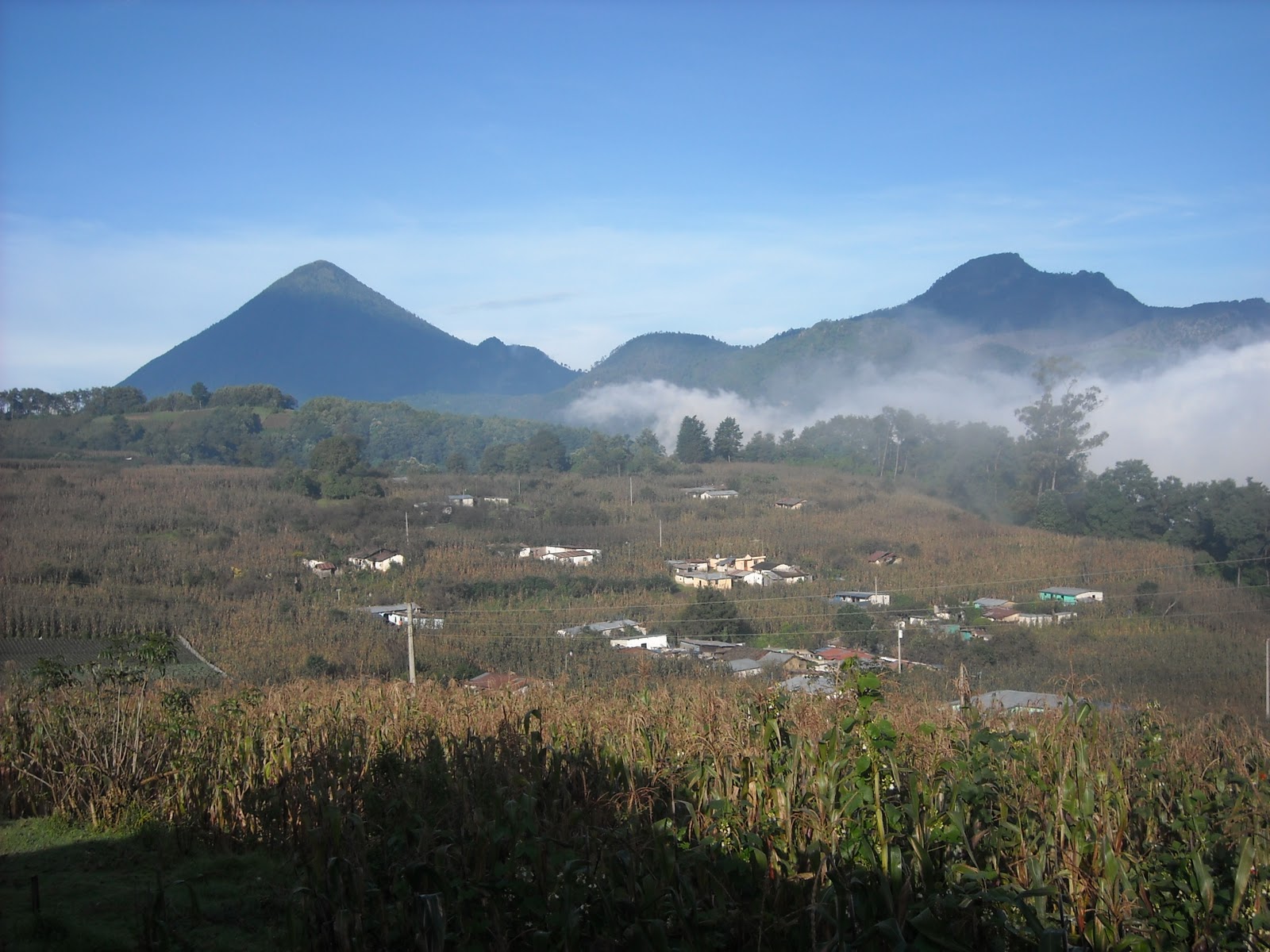
The village of Chuitziribal (you can see all but
just a few houses) and Volcan Santa Maria in the background to the left

Sunday we moved in with our host families. Two other girls and I stayed with a rather large family. They live in, what I think, is a pretty nice and big house. However, the house didn’t consist of its own servicios, and we had to walk about twenty feet out our front door into the cornfield to use the restroom, aka a small tin shack containing a concrete stump with a 10-foot hole within it. But nothing can replace walking out every morning to the view of a volcano to the left, rolling hills in front of us, and the small city of Cantel to the right. All drenched with clouds, both above and below us.

Cooking invueltos!
Monday we continued our Spanish classes. Our school’s location for the week was the local Evangelical church…or next to the river or sitting beside a cornfield—wherever teacher and student decided to “study” for the morning. Each morning our professors showed up in pickup trucks, ready to spend the morning teaching in a different location rather than the usual school in Xela. Monday afternoon after classes and after lunch, we met back at the church for a “clase de cocina local,” or a local cooking class. We learned how to make invueltos—fried goodness consisting of vegetables (including wiskiel, papas, and cauliflower!) wrapped in whipped eggs. They were SO delicious!


Tuesday after class we had a lecture about immigration and its presence/effects in the area. Can you believe that almost 1.3 Guatemalans live in the United States? Many of them only make it to Mexico. In this community of just over 30 families, 9 people are currently living in the US. In our home, one of the men had spent some time in the US, and there were a few other men in the community who had lived in the US for a short period of time. Immigrating to the US can be a long and hard process, and many don’t return back to Guatemala. It was very interesting to see how this issue that is a huge deal in the US also affects so many of these families personally.   In the afternoon, we traveled to some natural hot baths to bathe (which we all needed!). An hour in a prívate room with two feet of steaming hot water while listening to the rain fall upon the roof=ULTIMATE relaxation. :)

Mi maestra (professor) and me next to the river

Wednesday for class a bunch of us hiked up the mountain, and back down a little ways on the other side to the river. I love the fact that most of my class for the day consisted of hiking and chilling next to a beautiful river. :) After class, we all traveled to the glass factory in Cantel. We were able to watch the men make hand-blown glass ítems. I never knew why it was called “blown” glass until I witnessed many of the men participate in the very-much-skills-necessary process of standing off the ground and using a long hollow metal tube with a small piece of melted glass product on the end to create a dinner glass. Also, this particular factory participates in fair trade practices and has many respected rights for its workers, including benefits and decent working conditions. This was probably one of the most fascinating places we’ve visited yet. It requires a lot of skill to blow glass, and the process was intriguing. Wednesday afternoon we were going to visit Cantel again and see some more sites, but could not because of heavy rain. Wednesday night we had a celebration with the families, including a bonfire, s’mores, a pinata, and some fun games with the kids. And when we returned to the house, we spent at least an hour teaching our host family kids some English and learning a few words in Quiche. :)


A couple of the talented men adding the handle to
a pitcher at the factory

Thursday morning after class we visited with the director of the primary school in the community. Currently, it is “free” for kids to go to school. I say “free” because although the government is funding the school, the school does not receive its funds in a very timely manner and not in time for school to start. This year, the government has only sent half of its funds to the school, and there is only 15 days left of this school year. Where is the other half of the money? After the talk, we said goodbye to our professors. :( I am really going to miss my professor, Marleny. She and I had some great conversations, and discussed some great topics. She encouraged me a lot. I feel a lot more comfortable in my Spanish, and I think it’s mostly because of her. She also gave me a new love for literature, especially by Latin American authors. After this we ate our final meal with our families and said goodbye to our families. Also sad. :( Then we returned to Xela for the night.

Today we traveled to Antigua (a difficult trip! With many stomach and head aches due to decreasing elevation), and we’ll be here in the hotel for tonight and tomorrow, just to chill and relax some. On Sunday we head to EL SALVADOR! (I’ll blog more later about my Guatemala experience in general…I have so much to say!)

One thing I forgot to mention earlier that I’d like you to be praying about is my host family in Xela (Gloria and Ericka). Gloria just recently quit her job, is searching for another, just lost a nephew, and has a sister who recently had surgery to remove a cancerous tumor. She’s going through a lot, and I highly appreciated all that she did for me although she was going through a rough time. I will miss Gloria and Ericka so much. Please keep her and your family in your prayers.

Also be praying for safe travels for us as we travel to El Salvador. Words been getting out about a potential storm that’s brewing, and I’m hoping and praying it doesn’t bring more devastating landslides to the area.

Even though this post is long, I’ll probably be posting another soon! I want to share more about my thoughts during this time of transition to a different country. Hasta la próxima! :)